
I know a particular kind of Black person. You probably do too.
They know how to move through a room. I mean really move through it. Sitting in the meeting, face completely still while somebody says something they both know was out of pocket. Maybe a quick look at the other Black person across the table, just enough to say, you heard that shit too. But they keep it together. They know what to push and what to leave alone… They know how to disagree without becoming the problem, how to check somebody without making it a whole thing, and when to just sit there and let the silence fill the gaps.
If you’re reading, you might be that Black person. And more often than not, they’re the ones who move up. Why wouldn’t they? They know how to play the game. They’ve figured out what gets rewarded and what’ll get you put right back out the room. They know when it’s better to just leave things alone.
Somewhere along the way, they become somebody the room trusts. Black people have spent a long time getting good at surviving places we didn’t control. But lately I’ve been wondering what happens when the person who learned the room becomes the person running it.
I’ve watched enough Black people move into leadership to notice something I don’t think we talk about enough. Sometimes we finally get in a position to make decisions, just to turn around and enforce some of the same things we had to learn how to survive. And it doesn’t always look bad. Sometimes it sounds reasonable as hell. Professionalism. Readiness. Culture fit. Knowing how to carry yourself. Being strategic. Not making everything about race. But what happens when we get so good at surviving the standard that eventually we become the ones enforcing it? And do we even know when we’ve done it? I don’t believe most Black people spend twenty years navigating racism just to finally get some power and think, Well, I guess I’ll uphold white supremacy now. Nobody thinks about themselves like that.
Most people think they’re doing what makes sense. And after you’ve been rewarded for doing something long enough, it gets real easy to stop asking where you learned it in the first place.
So I started looking backward. There's nothing particularly new about this. Power has always needed people in the middle.
Let’s go back for a second. Stay with me.
European colonial governments learned pretty quickly that claiming land and actually governing the people who lived there were two different things. You can draw all the lines you want on a map, but somebody still has to deal with the people. And there weren’t enough European officials to do it themselves. So they needed people on the inside. People who knew the language, the customs, the families, the politics.
In parts of southeastern Nigeria, the British ran into a problem. Many communities didn’t have the kind of chief they were looking for. So Britain made one. They appointed local men, gave them colonial authority, and called them warrant chiefs.
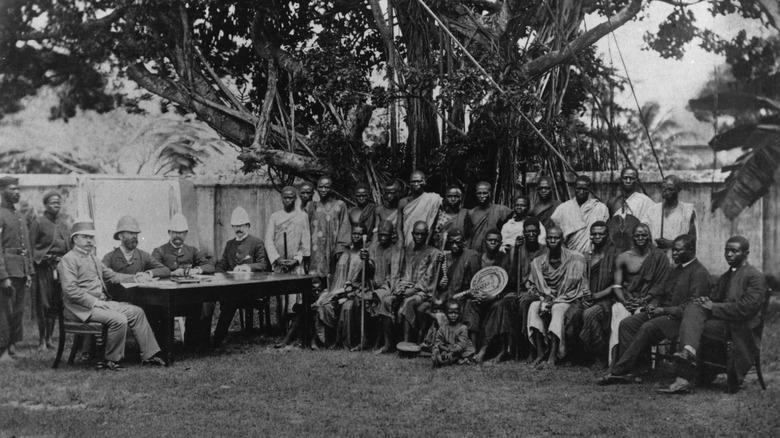
Now imagine living in that village. The man standing in front of you isn’t British. He knows your people. He speaks your language. He understands things about your community that the British officer probably never will.
But the authority? Still Britain. So, I wonder what he thought he was doing. Maybe he knew exactly what he was participating in. Maybe he thought somebody was going to occupy that position anyway, so it might as well be him.
Maybe he liked the status. Maybe he told himself he could protect his people better from the inside. Maybe sometimes he actually did.
There is an even uglier version of this in the history of slavery. Enslavers sometimes appointed enslaved Black people as drivers, putting them in charge of supervising the labor of other enslaved people. A driver could enforce work and participate in discipline while still being enslaved himself. I can’t imagine a more confusing place to stand. If another enslaved person experiences your authority through punishment, the fact that you are enslaved too doesn’t make the punishment hurt any less. But you’re still enslaved.
You still don’t have the freedom of the man who owns both of you. So where exactly do we put responsibility? I don’t know.
I’m not sure we have to clean that up and give it a clean answer.
And obviously, slavery, colonial rule and a Black professional sitting in an American office in 2026 are not the same thing. I’m not saying they are. What I’m looking at is how a system can get to the point where the people who built it don’t have to stand there personally making sure everybody follows the rules anymore. Eventually, other people learn how things work.
Black Americans know something about learning how things work. Somebody told you to straighten up before you walked into the store. Don’t touch anything. Somebody told you not to go in nobody’s house and embarrass them. My grandmother Lillie was old school. Like, old school old school. You could walk into her house wearing something she didn’t approve of, and she’d look you up and down so slow you already knew something was wrong. Sometimes she didn’t even have to say anything. You knew.
With Grandma Lillie, how you presented yourself meant something. Clothes ironed, hair done, nothing too short, nothing looking thrown together. You represented yourself, you represented your family, and if you were with her, you represented her. I laugh about it now, but I understand her differently as I get older. Grandma Lillie didn’t create the world she was preparing us for. She had just been Black in it a lot longer than I had. And she certainly wasn’t the first Black woman to think this way.
Around the turn of the twentieth century, Black women were having a much larger version of this conversation. Historian Evelyn Brooks Higginbotham would later call it the “politics of respectability.” Black Baptist women emphasized education, morality, manners, cleanliness and proper public conduct while living in an America damn near committed to portraying Black people as immoral and unfit. It’s easy to look at respectability now and see accommodation. I can see that too. But I also understand the strategy.
If America keeps pointing at Black behavior as proof of Black inferiority, I can understand somebody saying, Fine. We won’t give you a damn thing to point at. The problem comes when they are unfairly judging us by this standard becomes we need to live up to this standard. Those sound the same until you really sit with them.
This is where Grandma Lillie and the Black executive part ways for me.
When Grandma says, “Baby, you’re going to have to be twice as good,” she’s warning you about a barrier she doesn’t control. She can’t change who’s doing the hiring. She can’t make them see you differently. She’s trying to make sure you know what kind of world you’re walking into.
But if the Black person sitting across the desk from you controls the promotion and tells you the same thing?
Like family... You’re holding the promotion.
At some point, you’re not just explaining the rules anymore. You have enough power to ask why the rule is still there. I’m not sure we always notice when that happens.
White supremacy is old. Too old to still need a white person standing over every decision making sure it gets carried out. Eventually it becomes policy, habit, “professionalism,” just the way things are done around here. And we adjust.
Sometimes we adjust so well that we become successful. If keeping my mouth shut worked, if being twice as prepared worked, if knowing when to smile and when to swallow some shit helped me move from the bottom of the organization to the top, somewhere along the way I might stop seeing those things as what I had to survive. I might start seeing them as why I succeeded. And that’s where it can get ugly.
Because once I decide all that swallowing, smiling and knowing my place is part of what made me successful, I might start looking sideways at the Black person who refuses to do the same. Suddenly, she’s not principled, she’s difficult. He might be right, but he needs to learn how to pick his battles. And maybe she could lead one day, but she’s not ready yet.
And I can’t sit here like I don’t understand it. I’ve bitten my tongue. Let some shit slide because I knew making a thing out of it could cost me more than it cost them. I learned how to make people comfortable who weren’t nearly as concerned with my comfort. After doing that for fifteen years, it might be hard as hell to watch somebody come behind me and expect something different. Maybe part of me needs those rules to still mean something. Otherwise I might have to admit that some of what I called paying my dues was just shit I never should’ve had to pay for in the first place.
Nobody tells you when that shift happens. You just become the older person in the office one day. Some young Black woman comes in frustrated about the same mess you were frustrated about fifteen years ago. You know exactly what she means. You probably agree with her. And then you hear yourself telling her to be patient. Keep working. Be strategic. You have to understand how these things work .And maybe that is good advice.
It probably is.
But if I have enough power now to change how these things work, why am I still teaching her how to survive them?
Maybe that’s the blindness in all of this. We made it.
Ain’t no taking that away from us. But I do wonder how much of what we call success is actually ours, and how much of it is just proof that we learned the rules real damn well.
Because if we finally got enough power to change something, but we’re still teaching the next Black person how to survive it...
then what exactly did we make it to?
